

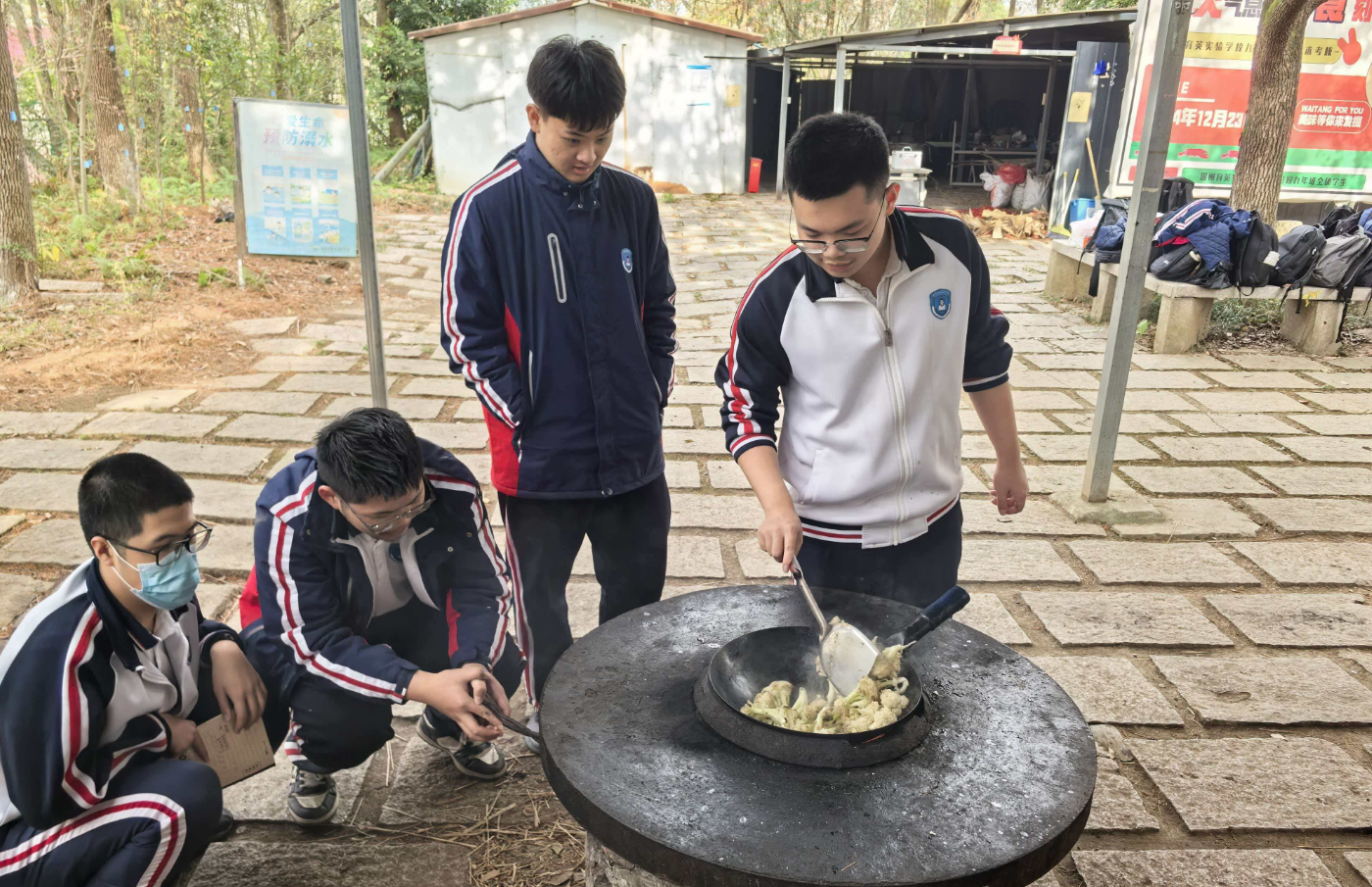
The most institutional answer is the Wenzhou Student Practice School. Its stated mission is "cultivate virtue, awaken intelligence, educate through practice." Ou Cuisine cooking is one of its core courses - layered by grade, alongside woodblock printing, clay modelling and net weaving. Students cook in practice kitchens and are graded on both process and result. The school says it plans to add VR-based training and a digital platform to make the base "smarter." In May 2026, it launched the city's first spring-break study programme: thirty concurrent courses across intangible heritage, labour, science and national defence, drawing 820 high-school students on the first day. The school sits inside a system that, according to the Wenzhou Education Bureau, now includes 204 city-level study bases, 105 study routes, and 1.66 million student visits in a single year.
The most intimate answer is on the coast. In October 2025, the Dongtou District Student Practice School invited four women - locally called "fishing family cooks" - into a campus home-economics room. Twenty-three stoves were lit at the same time. The women, wearing aprons, stood among the students as their "exclusive mentors." Children in the lower grades learned to make a four-dish, one-soup, one-platter meal from scratch - washing, cutting, cooking and plating in teams. One team built a platter called "Fishing Island Scenery," using seaweed and shrimp to mimic waves and boats, with the words "united as one" cut into the shape of a reef. In a separate workshop, a cook surnamed Zheng taught students to make a flatbread from a local seaweed called yangxicai - from the soaking ratio to the kneading force. A student named Lin said he had made egg-fried rice and tomato-and-egg soup, and that the experience had taught him "every grain of rice is hard-won." Another student, Ye Jiaqi, said she had not known yangxicai could be cooked that way. The school's principal, Ye Mingshou, said the next round would teach students "two dishes and one fish."
The most unexpected answer is a produce market. In February 2025, the "Modern Basket" state-owned market chain - ten standardised smart markets across Wenzhou - partnered with Nanpu Experimental Middle School. Students arrived as online-order fillers: receiving orders, collecting goods from stalls, checking, packing and handing them to delivery riders. Then they became food-safety inspectors, taking random samples of produce and running simple qualitative tests. The final task was called "Family Kitchen Manager." Each student designed a four-dish, one-soup menu, bought the ingredients at the market, went home and cooked the meal for their family. The market chain has over 3,000 square metres of practice space and has built its own local curriculum in cooking, crafts, planting and intangible heritage, tied to traditional solar terms and Wenzhou's food customs.
What connects these three is not a shared curriculum. It is the assumption that a child cannot understand what their city eats by reading about it. They have to touch the ingredients, stand next to someone who cooks, and make the food themselves - whether the teacher is a licensed instructor, a fisherwoman, or the market itself.