

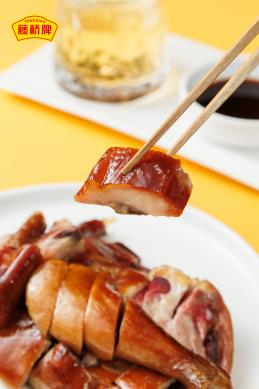
The most commercially proven answer comes from Tengqiao Food, a local snack brand whose smoked-chicken technique is recognised as intangible cultural heritage. Over the past thirty years, the brand has sold over 100 million smoked chickens and currently 200 hundred million duck tongues a year. However, with outdated packaging, it was losing traction among younger consumers. In 2024, the Lucheng District Publicity Department connected the company with the Wenzhou Fashion and Smart Manufacturing Design Centre. A team led by Chen Dan, a researcher at the China National Academy of Painting’s Public Art Institute, and packaging designer Wu Haifeng, dug into the history of the Shuomen Ancient Port — a Song Dynasty trading harbour excavated in downtown Wenzhou — and the city’s opera traditions. They turned port imagery and opera motifs into a modern visual identity, redesigned the duck-tongue packaging from scratch, and launched a co-branded edition titled "Ancient Port, Ancient Opera." In four months, the redesigned lineup drove 75 million yuan in duck-tongue sales — 20 million from the co-branded edition alone. The product entered the China-EU Geographical Indications Pavilion and was promoted through Tiktok livestreams. The company’s market director, Pan Yijie, said the redesign was "not a simple packaging upgrade, but a full reinvention of brand identity, distribution channels, and consumer perception."
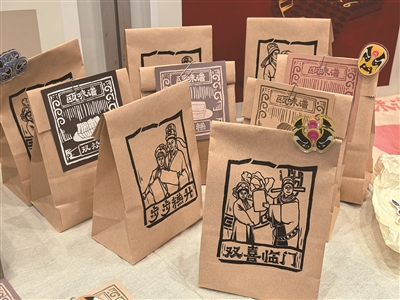
The most experimental answer comes from a classroom. At Wenzhou Business College, a student named Jin Jiaqi designed a pastry brand called "Ou Flavour Spectrum." The visual identity draws from the Ou Opera face mask, carried through traditional woodblock print motifs, and built upon Shuangchuigao — a classic local double-steamed rice cake. Three layers — opera, craft, food — stacked into one product. Meanwhile, Chen Guoer, another student in the same program, redesigned the packaging for Wenzhou’s traditional "Zhuangyuan Cake" (Top Scholar Cake), taking inspiration from the Ou Opera play Zhuangyuan Zhang Xie and titling the line "Triple Firsts." The school runs an Ou Yue Intangible Heritage and Fashion Design Research Centre, partners with Aliyun for AI-assisted heritage-element extraction, and has set up a livestream base to help students sell what they make. Their mentor, Xie Ruile, acknowledges that bridging the gap between student concepts and commercial viability remains a challenge: "Students excel at aesthetic expression, but they often fall short when dealing with materials, production costs, and market realities."
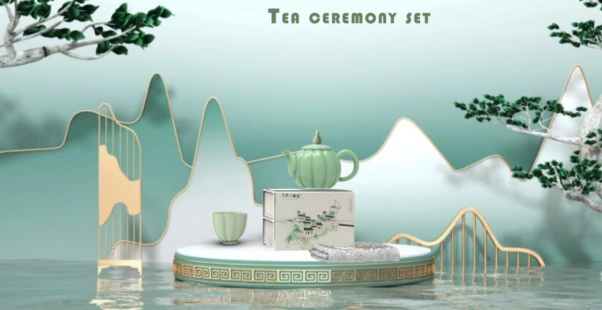
The oldest answer is in a museum. In 2025, the Wenzhou Museum ran a cultural-creative design competition. One standout entry by designer Tan Hui is an Ou kiln celadon tea set. Its glaze re-creates a carved-pattern celadon bowl from the Northern Song Dynasty, featuring a melon-ribbed teapot body, cups etched with historical maps of the ancient city wall, and a teapot lid knob sculpted as the King of Dong’ou — the ruler who founded the kingdom in 192 BC. Designed as a stackable set catering to tea enthusiasts and corporate gift buyers, it won the Fan Favorite award through online voting. Another entry in the same exhibition turned a chopstick gift set into a vessel for Ou embroidery, Ou kiln, and indigo-printed calico, with a turquoise stone on the chopstick tail to echo celadon glaze. A third designed a tiger-shaped teapot from an Eastern Jin Ou kiln lamp stand, with a stackable teapot-and-cup set based on the Chinese philosophical concept of "round heaven, square earth."
What connects these three is not a shared medium — one is a snack, one a pastry, and another a teapot. It is the belief that culinary culture shouldn't be locked away behind glass. You print it on a bag, bake it into a cake, or fire it into clay — and then someone carries it home.