

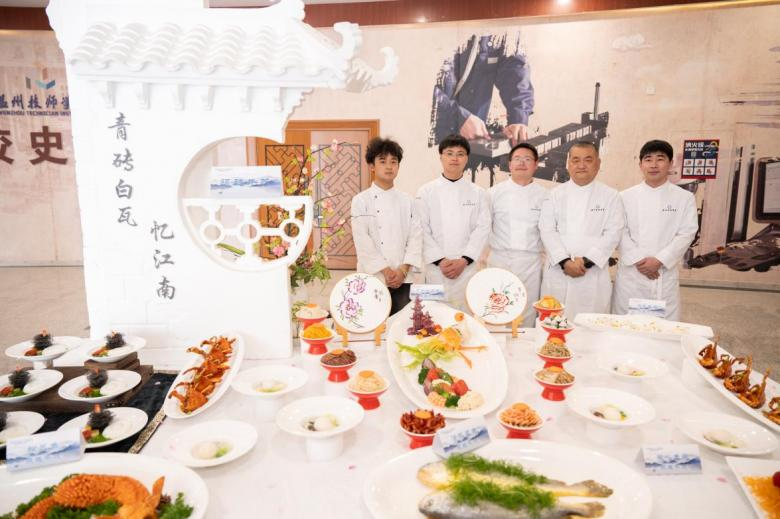
The first tier is the oldest. Wenzhou Huaqiao Vocational Secondary School introduced its culinary arts program in 1984. Forty years on, the school boasts that over 85 percent of executive chefs and kitchen managers in the city’s four-star-and-above hotels are among its alumni. The pipeline operates much like an assembly line: raw talent in, skilled labor out. But the "factory floor" here is a 120-million-yuan training complex featuring 587 individual workstations, 16 practice kitchens, a master chef studio named after Ou Cuisine legend Pan Xiaolin, and an on-campus Ou Cuisine Research Institute. Students rotate through working kitchens in over fifty high-end hotels — including the Shangri-La and Sheraton — under an industry-standard 4D management system. The school has authored its own specialized textbooks on Ou Cuisine, built a curriculum centered on heritage and innovation, and runs an integrated secondary-to-higher vocational track that admits forty junior high school graduates each year.
The second tier is newer and more selective. In 2025, Wenzhou Technician College launched its "Wenzhou Cuisine Master Class" — an elite track within its Chinese Culinary Arts program where classes are taught not by academic lecturers, but by veteran industry masters: Zhou Xiong, recognized by Zhejiang Province as an official inheritor of Ou Cuisine cooking techniques; Jin Guangwu, a national-level inheritor of Wenzhou culinary heritage; and Zheng Zuobo alongside Chen Fu, both honored as China Culinary Masters. Over 80 percent of instruction takes place in simulated commercial kitchens rather than traditional lecture halls. Offering culinary education since 1979, the college currently enrolls 1,310 students, making it the second-largest food-service program in the province. Its graduates have catered for naval units stationed in Wenzhou, served in volunteer kitchens at the 2023 Asian Games, and now staff Chinese restaurants across Europe.
The third tier is the most condensed and accessible. In August 2025, the Wenzhou Municipal Trade Union hosted a two-day culinary workshop for workers facing career transitions. Forty participants enrolled. The instructor was Ke Wuyi, founder of the renowned Yixiangtang Restaurant Group. He opened with a signature dish, "Plum Blossom Oxtail," and concluded with hand-minced "Water Chestnut Pork Balls" — a classic dish that served as a mandatory assessment for top-tier chef certification back in the 1970s. Working in pairs at practice stations in a training facility on Aidengqiao Road, students honed their knife skills, wok tossing, and seasoning with fresh ingredients. Every participant walked away with a completion certificate and a copy of A Hundred Dishes of Ou Flavor.
The same master teaches an Ou Cuisine course at the city’s Intangible Cultural Heritage Evening School — a public initiative offering night classes across five municipal districts, alongside courses in Ou embroidery, rice sculpting, and local opera. The program is brief, the techniques are entry-level, and the attendees aren't aspiring professionals. They are simply learning what their city’s traditional heritage tastes like when crafted by their own hands.
These three tiers operate within a broader strategic blueprint. In June 2025, the Wenzhou Municipal Government unveiled a three-year action plan to cultivate culinary talent as part of its bid to join the UNESCO Creative Cities Network as a City of Gastronomy. The plan sets ambitious targets by 2027: expanding culinary enrollment to over 2,500 students, establishing three new public training bases and fifteen master studios, and certifying one hundred official "Ou Cuisine Master Chefs." The schools are not working in isolation; they are vital components of a unified system — one attempting to keep a regional cuisine alive by putting it into as many hands as possible.