

Eat tangyuan, and you are a year older. A Wenzhou saying notes: "After eating tangyuan, you become a year older." Behind it lies a whole way of reading time. In Wenzhou tradition, the Winter Solstice is the pivot where yin and yang shift — after this day, daylight lengthens and yang begins its return. People step forward with the rhythm of nature, a step called "becoming a year older." So the solstice tangyuan is not just a snack, but a ritual: children grow a year; adults grow a year; the elderly grow a year. Sharing a bowl at the table, the whole household crosses an invisible threshold together — aging together, living together.
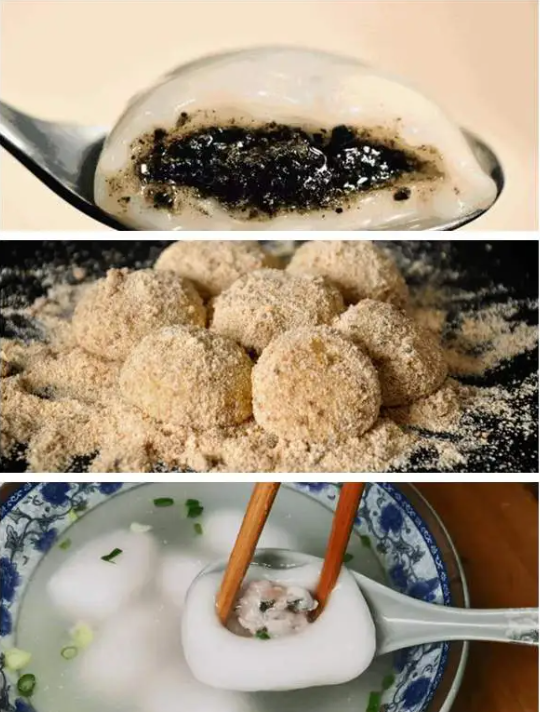
Five ways to make tangyuan. The sweet classic is the black sesame tangyuan: glutinous rice flour rolled round and filled with black sesame mixed with lard and sugar. Boiled and bitten into while hot, the black filling flows slowly — hot and sweet. There is a precise way to eat it: bite a small hole, blow twice, sip the filling, then eat the skin. The savory preference is pork tangyuan: pork at three-to-seven or four-to-six fat-to-lean ratio, seasoned with soy sauce, cooking wine, and ginger, wrapped in rice skin; a bite releases rich broth. Wenzhou pork tangyuan are larger than sesame ones with thicker skins — three or four make a meal. Rolling-sand tangyuan (leisha tangyuan) is a sesame variant: drained and rolled in toasted soybean flour, golden and dry, eaten by hand. The coarse, roasted scent of soybean flour comes first, followed by smooth black sesame. Oil-fried tangyuan are tiny solid balls the size of a fingernail, pan-fried until golden, then tossed with aged wine and brown sugar until a caramel shell forms, filling the kitchen with sweet and wine aromas. In Yueqing, sweet-potato tangyuan (fanshu wanzi) prevails: steamed sweet potato mashed into rice flour, wrapped around a mushroom-and-pork filling, cooked to a pale orange — softer and sweeter than pure glutinous rice.
Maci and the maci vendors. Besides tangyuan, Wenzhou eats maci on the solstice: steamed glutinous rice pounded hot into a smooth paste, pinched into pieces, and rolled in bean or sesame flour. Locals usually dip it — a piece of maci dropped into sugar mixed with soybean flour, coated, and eaten. Around the solstice, vendors from the countryside appear in the old city's lanes carrying their shoulder poles. They knead cooked glutinous rice paste into balls, bring sugar and soybean flour, and sell as they prepare. The most skilled spin the paste with both hands into a hollow ball — smooth outside, like a table-tennis ball — then roll it in soybean flour. Children clutch a few cents and wait for the spin, a single turn drawing every child in the lane.