

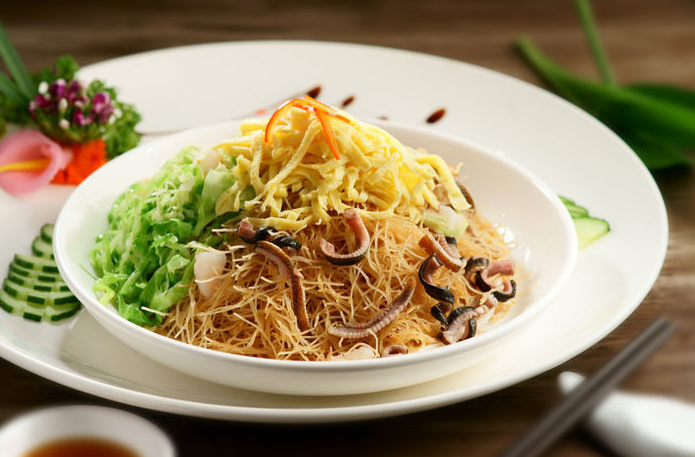

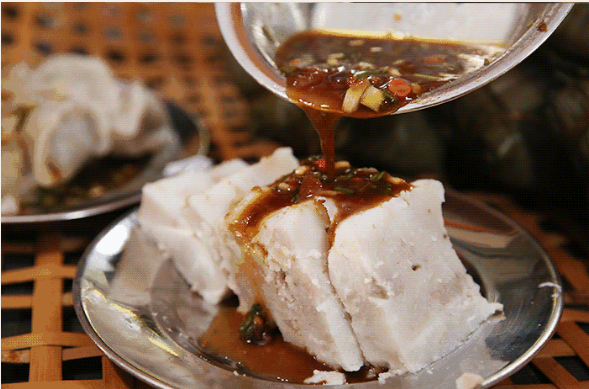
The feast's fixed triangle. The Mid-Autumn menu in Wenzhou once ran to four cold plates and ten hot courses — roast goose or fresh-braised chicken, celery with gizzards, braised pork, white shrimp; stir-fried rice noodles, taro with pig's trotters, chestnut duck, scissors-cut wontons, braised yellow croaker, steamed crab with wine, fried crisps, mushroom with water bamboo, red-date lotus-seed soup, and two canned sides. Ou cuisine veteran Ye Guoguang recalled that an 1980s Mid-Autumn feast counted as "high-end," with almost everything from local sources: Yongqiang white shrimp, Lingkun mud crabs, Yongjia Shagang rice noodles, Yantou tofu skin, Daruoyan chestnuts, Ouhai taro, and the season's returning "osmanthus" croaker.
But three dishes never move: old duck, taro, rice noodles. Behind them is a legend tied to revolt. In the late Yuan and early Ming, Wenzhou people and rebel forces agreed to rise on Mid-Autumn night, and spread the message through food: taro (yutou) sounding like "no head," rice noodles (fengan) like "divide the offices," and lamp cake (denggao) like "waiting for the beheading." After the uprising succeeded, the three became the fixed dishes of the Mid-Autumn family table, passed down generation to generation. Whether the story is true, no one can now say; the taste of the table is real.
The duck must be a Muscovy duck raised at least a year, firm-skinned, best simmered. Fresh chestnuts, just harvested, turn golden in the pan. Braised together, the duck fat melts into the broth and the chestnuts drink in the meat — the whole house smells of the harvest. Taro is chosen small and even, boiled with skin on, peeled hot and dipped in shrimp-roe paste: savoury and strong against soft and mild, the two fighting in the mouth — Wenzhou calls it "taro dipped in shrimp roe." The rice noodles must be from Yongjia's Shagang: fine, unbroken, cooked strand by strand without sticking. Stir-fried hard with pork shreds, egg, cabbage and dried shrimp, the pan must sizzle — that sound is the test.
The osmanthus croaker. In the eighth lunar month, yellow croaker migrate back to Wenzhou's near shore, fattened for winter and sharpened by the osmanthus-season chill. Wenzhou calls them "osmanthus croaker" — the best fish of the year. The preparation is simple: gutted, scored, stuffed with ginger and scallion, steamed eight minutes over fierce heat, then dressed with hot oil and soy sauce. The flesh parts at a touch of the chopsticks, white as garlic cloves, sweet against the soy at the bottom of the plate. Wenzhou's old saying runs: "no banquet without croaker" — the Mid-Autumn reunion table, missing this fish, is not complete.
The eighth of the eighth: sesame mooncakes. Wenzhou's mooncake is not Cantonese or Suzhou style. Small, thin-skinned, packed tight, it is sesame-filled — hence the rhyme "eighth of the eighth, mooncake filled with sesame." The filling mixes peanuts, candied winter melon, longan, melon seeds, red melon, preserved fruit and pork fat, minced and bound with sugar and lard; the pork fat melts in the bake and threads the dried fruit's fragrance together, rich without being greasy.
Drinking with the moon. In the old city, elders keep the custom of the "moon-facing drink": a small table in the courtyard, mooncakes, fruit, a pot of aged wine, a few small plates — soy-sauce duck tongue, braised beef, fried peanuts — drunk slowly facing the moon. No rush, no show. The moon climbs from east to west, the wine goes from full to empty. It is less drinking than keeping the moon company: of three hundred and sixty-five nights, only this one is worth the wait.