

Story
The old town: Wuma–Mochi Historical and Cultural District. Wenzhou's evening begins in its oldest quarter. The district runs east–west along Chan Street, Wuma Street, and Gongyuan Road, crossed north–south by Jiefang Street — 1.4 kilometres in a fishbone grid connecting 14 back alleys. Landmarks stayed put while the district grew: the Drum Tower, Mochi Fang, and the former residence of Zhu Ziqing. The food spans both ends of the spectrum — Ou Cuisine restaurants such as Yipin Seafood, Ouyanfu, and the Wenzhou Grand Restaurant's Ou Cuisine Hall, alongside time-honoured snacks like Changren Wonton Shop (Michelin Bib Gourmand), Chenhui Fish Balls, Shouying Pig Intestine Noodles, and century-old Wuweihe. Come between 18:00 and 22:00, when the lanterns are lit and the alleys are at their liveliest.
The riverside: Nantang Cultural Tourism Zone. Nantang is Wenzhou's most theatrical evening scene. Its river and street have existed for over a thousand years; the centrepiece is the "Tanghe Night Painting" waterfront light show, which tells the region's story in six themed chapters projected on water. Dining concentrates along the bank: De'erle Nantang Grand Hotel, Zheng Zhengliang Seafood (Michelin Bib Gourmand), a Song-dynasty-themed hotel pairing Nanxi opera with Ou Cuisine, and dozens of Ou Cuisine restaurants in all. Most visitors watch the light show first, then walk to dinner — 19:00 to 22:00 is the ideal window.
The water town: Wutian Old Street. In Ouhai District, Wutian Old Street rebuilt a corner of Wenzhou's historic water town system. Twenty-six antique courtyard complexes line a 500-metre riverside strip of arcaded houses along the Wenruitang River; lanterns reflect in the water at dusk. The street runs four signature annual events — the Shangyuan Festival, the Flower-Picking Festival, a music festival, and the Wutian Market. Eat at the Wutianji Jiangnan Fish Market for home-style Ou Cuisine, or graze on fish cakes, Jiangxie Sheng (raw marinated crab), and almond jelly from street stalls; more than 30 heritage stalls — Ou kiln ceramics, flower arranging, paper-cutting — share the street. Hanfu try-ons draw visitors in period costume, and the S1 light rail line stops nearby.
The neighbourhood: Xinqiao Food Street. Jinhong East Street in Xinqiao shows Wenzhou's late-night snack culture in its most unpretentious form. Three hundred and fifty metres long, 99 storefronts, 65 of them food stalls: barbecue skewers, seafood, potstickers, and "paopao" fried snacks, under a continuous run of neon signs. It is a community street where locals come for cheap, late-night meals from 18:00 until 01:00, liveliest on summer nights. Popular spots include Xiaogezi Gourmet Pavilion (Xinqiao branch) and Aqing Lobster. Signage is limited, so a translation app helps.
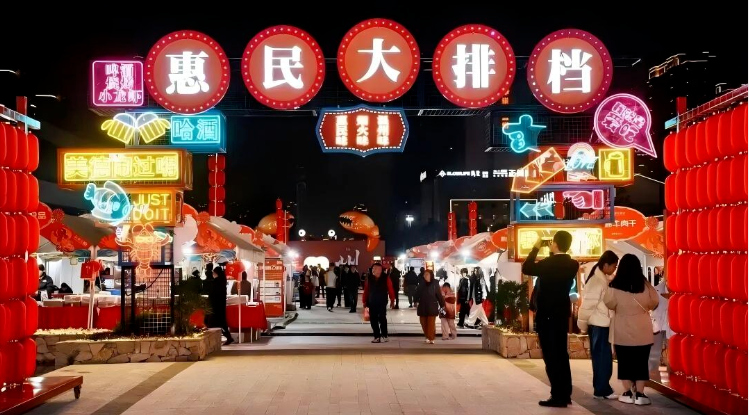
The hub: Huimin Open-air Food Court. The newest of the six, it was built directly at a light-rail station — seamlessly connected to Huimin Road Station on Wenzhou Rail Transit Line S1. Its logic is pure convenience: a visitor's "first meal upon arrival, last meal before departure" without leaving the transit hub. At stalls like Zhengliang Seafood, Xingyue Fishing Port, and Yanting Wharf, seafood is netted live from tanks and cooked on the spot, while duck tongues, fish cakes, and pork meatballs cover the home-style offerings. Smoke from the barbecue and flames from the wok fill the open-air seating area from 17:00 to 22:00. For travellers wanting to experience Wenzhou's seafood culture with the least friction, Huimin is the easiest starting point.
The county town: Ruian Zhongyi Street. Forty minutes by car from downtown Wenzhou, Ruian's Zhongyi Street shows how this pattern extends beyond the main city. The core consists of protected heritage sites: Yuhai Tower, a landmark library, and Liji Medical Hall, restored under the principle of "conserving the old as it was," with heritage workshops and creative spaces integrated within. Eat at the Caocun Jinshi Restaurant for the imperial-scholar banquet, then browse ancient courtyards serving nine-layer cake and baked cakes; wooden movable-type printing and indigo-printed calico dyeing operate as hands-on workshops. The street is best visited in daylight: 09:00–17:00 for heritage sites and workshops, with lunch between 11:00 and 13:00.
What the six streets add up to. History, riverside, water town, neighbourhood, hub, county town: Wenzhou's night food scene is not a single setting but six, each answering a different question — where the old city eats, where the city shows off, where it relaxes, where it comes down to earth, where it meets transit, and how far this pattern reaches into the countryside.