

Story
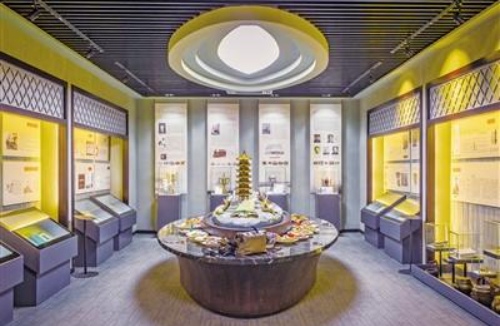
The museum: Ou Cuisine filed by century. The Zunyue Ou Cuisine Museum sits inside Wenzhou Student Practice School, on the city's southwestern edge — an unusual address for a food museum, and one that says something about its purpose: this is a place for learning, not just looking. The plaque bearing the museum's name was written by Wu Pinzhen, chair of the Wenzhou Calligraphers Association; the characters "Ou Yun" (Ou Charm) above it by Jiang Junxian, president of the China Cuisine Association. Inside, three zones divide the work: a main exhibition hall, a citizens' school where cooking classes run, and a reconstructed Wenzhou stove.
The main hall arranges Ou Cuisine by century. The wall chronology starts with the earliest foodways of the region, runs through the Qin, Han, Jin, Tang, Song, Yuan, Ming, and Qing dynasties, and reaches the present; 40 display cases hold newspapers from the 1930s, photographs from the 1950s, cookbooks from the 1970s, competition trophies from the 1990s, and recipes from the 2000s — an archive of a cuisine as it aged. Beside them sit the objects of ordinary kitchens: pots and bowls of Ou-Yue households, hotpots from different eras, ceramic plates. Against a model of Jiangxin Island, the museum's showpiece dish models line up — among them "Memory · New Year's Eve Dinner," which recreates the Wenzhou custom of the fen sui feast, the family dinner that divides the old year from the new. A 1977 copy of the Chinese Culinary Compendium (Zhejiang Volume), donated by Ye Guoguang, an Ou Cuisine chef, lists eleven Ou Cuisine classics and marks the moment Wenzhou cooking entered a national publication.
The traditional Wenzhou stove is the museum's most domestic exhibit: a stove, built by folk craftsmen, of the kind that once presided over Wenzhou households. In Wenzhou the Kitchen God was "master of the household," and on Little New Year's Eve — the 23rd day of the twelfth lunar month — families made offerings to him before the New Year; the museum keeps that custom visible. The museum itself serves no meals, but its citizens' school runs regular home-cooking classes, so visitors can cook as well as read. Call ahead (0577-86176133) to confirm opening days, as the school sets the schedule.
The village hall: history you can eat. In Caocun, Ruian, food memory takes the form of a banquet. Between the Southern Song and the Ming dynasty, this single village produced 82 jinshi — scholars who passed the highest imperial examination — and the Jinshi Restaurant on the ground floor of the Jinshi Hall turns that record into a menu. "Ascending to the Top" is noodles boiled in glutinous-rice wine with dried shrimp, mushrooms, and egg; "Leaping the Dragon Gate" is braised carp kept whole, scales on; "Feathered Hat with Tassels" is pork-fat dumplings; "Clean and Upright" is lotus-seed soup. The dishes are named for exam metaphors, but the ingredients are Caocun's own. Lunch hours run 11:00–13:00; visitors can tour the hall first, then sit down to the past.
The riverside: heritage in progress. At Nantang Cultural Tourism Zone in the city centre, the display is alive. The riverside district brings together national and provincial heritage crafts — hair embroidery, Ou sculpture, Ou embroidery — in what the zone calls its "intangible heritage cluster," and threads them into its dining scene. Building 4 of the Nantang Style Area houses De'erle Nantang Grand Hotel, where Ou Cuisine itself — a provincial-level intangible heritage — is the menu. Michelin Bib Gourmand pick Zheng Zhengliang Seafood sits nearby; a Song-themed hotel pairs Nanxi opera performances with Ou Cuisine at the table. Regular heritage markets and folk festivals keep the street busy, and at Baigong Hall visitors can watch Ou embroidery and boxwood carving being worked. The zone's best hours are 19:00–22:00: watch the "Tanghe Night Painting" light show over the river first, then dine along the bank.
What the three spaces add up to. Paper, plate, and street: Wenzhou archives its food history, cooks it, and keeps making it. The museum explains where Ou Cuisine came from, the village hall serves what it meant, and the riverside shows that it is still being written.